Great Cities of Islam Through History 3: Jerusalem — A City That Weeps for a Glory That Will Never Die
Lyla HamdanInFor New Muslims|11/03/2026
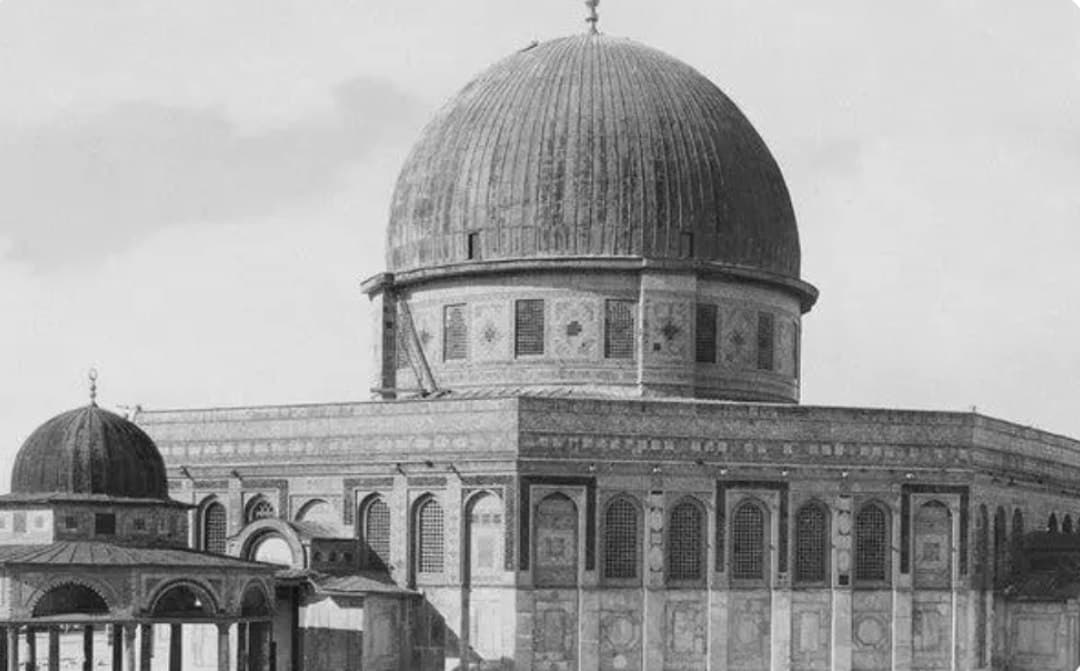
After Makkah, the birthplace of revelation and the direction toward which Muslims pray, and Madinah, the home of the Hijrah and the capital of the first Islamic state, the series “Great Cities of Islam Through History” turns to a city unlike any other — a city where the histories of the Prophets converge, whose name is forever linked to the Night Journey, which once served as the first direction of prayer for Muslims, and which, over the centuries, became a stage for a prolonged struggle over land, identity, and collective memory.
Jerusalem: The City of the Prophets and the Gateway to the Night Journey (Al-Isrāʾ)
Jerusalem lies at the heart of Palestine, occupying a unique standing in Islamic doctrine (ʿaqīdah) and history.
It was to Jerusalem that the Prophet Muhammad ﷺ was taken on the Night Journey, as mentioned in the Noble Qur’an:
“Exalted is He who took His Servant by night from al-Masjid al-Haram to al-Masjid al-Aqsa..”
(Qur’an 17:1)
It is from this city that the Ascension (al-Miʿrāj) became entwined with the Islamic memory.
For this reason, Jerusalem was never merely a city that the Muslims conquered and then left behind. Rather, it became an integral part of the religious geography of the Muslim world.
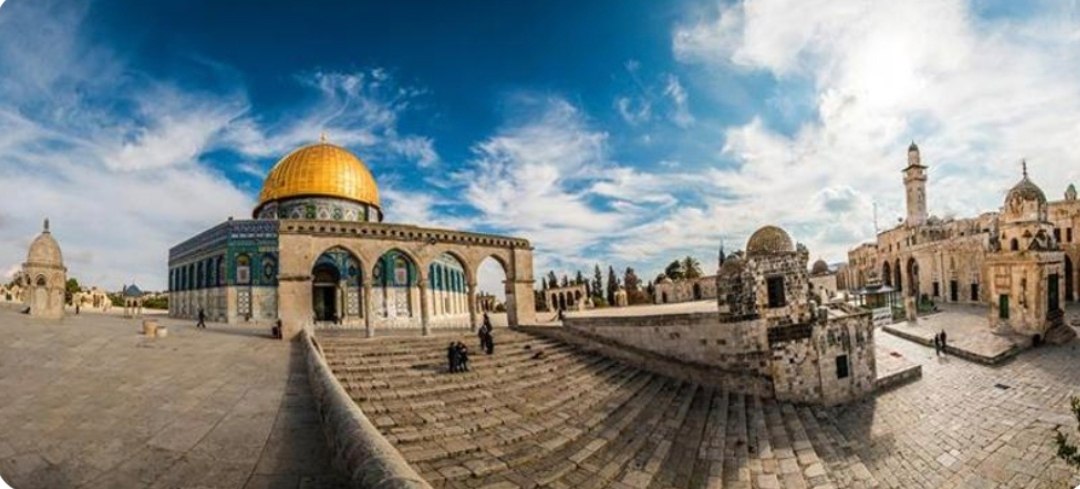
Al-Masjid al-Aqsa
The Islamic Conquest: When Umar ibn al-Khattab Entered Jerusalem
In 15 AH/636 CE, the Muslims achieved a decisive victory over the Byzantines at the Battle of Yarmouk, marking the beginning of a new chapter in the history of the Levant (Bilād al-Shām).
Following this victory, Jerusalem came under the authority of the Islamic state, governed from Madinah, until it was freed during the reign of the Caliph, ʿUmar ibn al-Khaṭṭāb (may Allah be pleased with him), in 16 AH / 637 CE or 17 AH / 638 CE—depending on differing historical accounts and chronologies.
Islamic sources associate the conquest with Umar’s arrival in Jerusalem, where he received the keys to the city from its patriarch, Sophronius.
The entry of Jerusalem into the Islamic state marked a major turning point. The city became part of the Islamic realm and joined the broader sphere of civilization that was taking shape across the Levant at the time.
The Umayyads: When Jerusalem Became an Islamic Center of Civilization
The Muslims did not merely preserve Jerusalem; during the Umayyad era, the city witnessed one of the most significant periods of its most important monumental architectural periods.
During the reign of Caliph Abd al-Malik ibn Marwan, the Dome of the Rock (Qubbat al-Ṣakhrah) was constructed, with its completion dating to approximately 72 AH/691 CE. standing as one of the greatest masterpieces of early Islamic architecture.
The Dome of the Rock was far more than an architectural structure. It held profound religious, political, and cultural significance, and over time became one of the most recognizable symbols of Jerusalem and the Islamic world. According to the Jerusalem Islamic Waqf Administration, it was built during the Umayyad period by order of Abd al-Malik ibn Marwan, under the supervision of Raja’ ibn Haywah and Yazid ibn Salam.
Subsequently, expansions and major construction projects took place at Al-Masjid al-Aqsa throughout the Umayyad period, turning Jerusalem’s sacred precinct (al-Manṭaqah al-Muqaddasah) one of the most prominent centers of early Islamic architecture.
It was during this period that Jerusalem began to take shape as an Islamic center of civilization, bringing together religion, architecture, scholarship, and political life.
Jerusalem: City of Sacred Knowledge and Frontier Devotion (Ribāṭ)
Jerusalem’s significance was not limited to the sacred precinct alone. The city also attracted scholars, devoted worshippers, and travelers, and hosted circles of learning and Hadith transmission.
Furthermore, the city maintained its strategic position along the caravan and pilgrimage routes connecting Egypt, the Levant, and the Hijaz, becoming a link between different regions of the Islamic world.
In later Islamic eras, most notably the Ayyubid and Mamluk periods, scholarly and religious institutions surrounding Al-Masjid al-Aqsa multiplied, giving rise to an array of madrasas (scholarly schools), rubuṭ (hospices/frontier retreats), and lodges (zawiyas).
The Crusader Occupation: The Fall of the Holy City
After more than four centuries of Islamic rule, Jerusalem entered an exceptionally harsh period. In 492 AH/1099 CE, the city fell into Crusaders' hands during the First Crusade, following a prolonged military siege.
The fall of Jerusalem sent shockwaves throughout the Islamic world—not merely due to the loss of a strategic stronghold, but primarily because of its sacred status tied to Al-Masjid al-Aqsa.
The recovery of Jerusalem became a prominent objective in the discourse of a number of Muslim scholars and leaders. Gradually, a political and military effort emerged to reunify Muslim forces to confront the Crusader states.
Nur al-Din Zangi: The Beginning of the Road to Liberation
Prior to Saladin (Salah al-Din al-Ayyubi), there was a vision set in motion by Nur al-Din Mahmud Zangi. He worked to unite vast parts of the Levant and confront the Crusader presence, and his name became associated with the cause of Jerusalem even before its eventual liberation.
Thus, the liberation of Jerusalem was not a sudden decision made by a leader in a fleeting moment. Rather, it was the culmination of years of sustained political, military, and intellectual efforts.
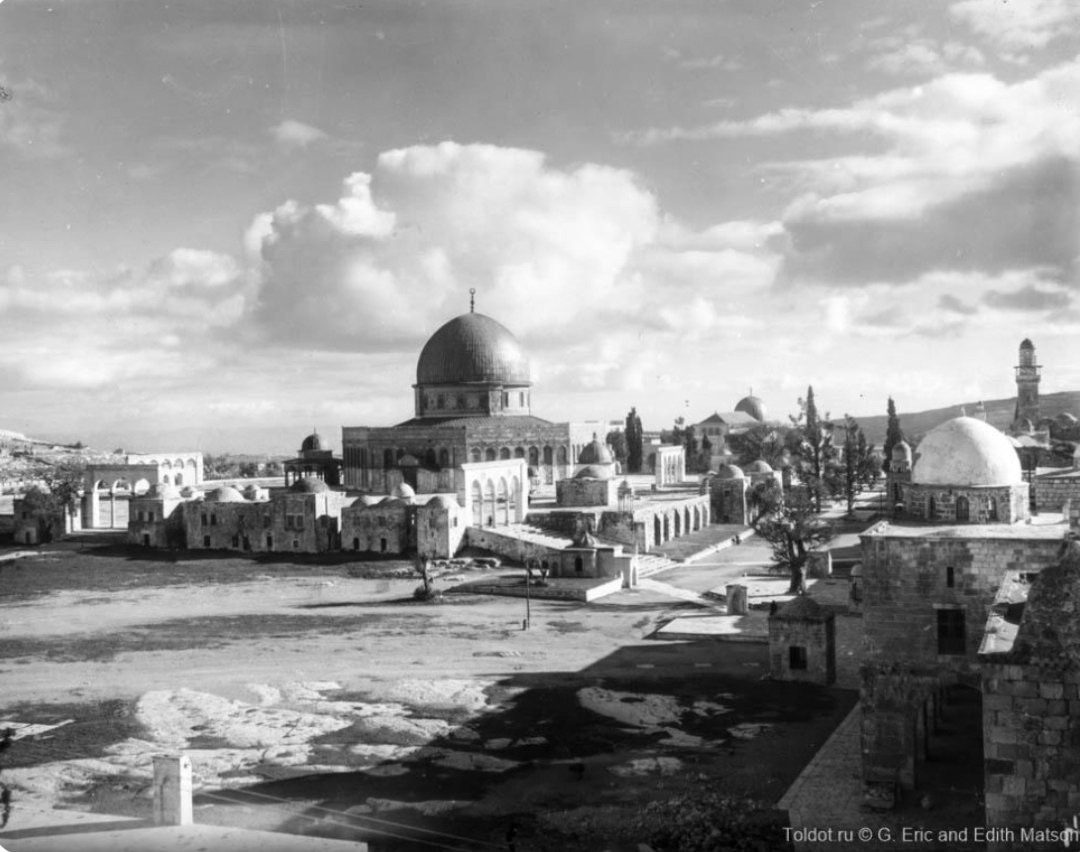
Al-Masjid al-Aqsa, Before Urban Expansion
Hattin: The Battle That Opened the Road to Jerusalem
The decisive moment came on 24 Rabi‘al-Thani 583 AH/4 July 1187 CE, when the army of Saladin (Salah al-Din al-Ayyubi) defeated the Crusader forces at the Battle of Hattin.
This victory marked a major turning point. In its aftermath, the main military strength of the Kingdom of Jerusalem collapsed, the Muslims recovered numerous cities and fortresses, and the road to Jerusalem lay open.
Historical sources indicate that Salah al-Din advanced toward Jerusalem in Rajab 583 AH/1187 CE, after reclaiming vast areas of Palestine.
Salah al-Din Reclaims Jerusalem
On 27 Rajab 583 AH/2 October 1187 CE, the Muslims entered Jerusalem after a siege and negotiations that ended with the surrender of the city.
The circumstances were radically different from those surrounding the Crusaders’ entry nearly nine decades earlier. Salah al-Din chose a negotiated settlement and granted safety to those inside the city, subject to the terms of ransom, rather than repeating the massacre that had occurred when Jerusalem fell in 492 AH / 1099 CE.
The return of Jerusalem to Islamic rule was one of the most remarkable moments of Ayyubid history. In Muslim historical memory, Salah al-Din became forever associated with the city’s recovery after decades of Crusader occupation.
Jerusalem in the Ayyubid and Mamluk Eras
After its recovery, Jerusalem entered a new phase of construction and patronage. Its religious institutions were reorganized, madrasas were established, and the presence of scholars and jurists grew. The city became an important part of the network of scholarly centers across the Levant.
The Mamluks later came to power, and Jerusalem witnessed further expansion in its madrasas and religious institutions. The city flourished with scholars, students, and pilgrims.
In this way, Jerusalem maintained its distinguished status even as the major centers of political power shifted to other cities, such as Damascus and Cairo.
What Makes Jerusalem an Exceptional Islamic Center of Civilization?
Jerusalem brings together a combination of features rarely found in any other city in quite the same way.
Religious significance: The Al-Aqsa Mosque and the city’s connection to the Night Journey (al-Isra’).
Historical significance: The conquest during the caliphate of Umar ibn al-Khattab and the liberation led by Salah al-Din.
Scholarly significance: The madrasas, circles of learning, and scholars associated with the city.
Civilizational significance: The Dome of the Rock, the Al-Aqsa Mosque, madrasas, markets, and city walls.
Symbolic significance: Jerusalem has become a symbol of a prolonged struggle over land, sacred sites, and identity.
For this reason, Jerusalem has never been merely a city on the map of the Levant. It has always been a city whose significance transcends geographical boundaries.
From Makkah to Madinah, and then to Jerusalem, the first three stops on our map of “Great Cities of Islam Through History” are now complete — three cities that shaped the great beginnings: Makkah, the cradle of revelation; Madinah, the capital of the Islamic state; and Jerusalem, the gateway to the Night Journey and the land of sacred sites.
Aslam Mohamad
Related Articles

“Great Cities of Islam Through History 2”: Madinah — Where the First Islamic State Was Born
If Makkah is the cradle of revelation and the direction toward which Muslims pray, then Madinah is the place where the Islamic mission took shape as a state, a society, and a civilization. It was here that Islam moved from a period of persecution and vulnerability to the building of an Ummah. Here, the Prophet Muhammad ﷺ spent the final years of his life; from here, armies, envoys, letters, and messages were dispatched; here, the Companions gathered around the Messenger of Allah ﷺ; and from here emerged a state that would soon expand beyond the Hijaz and reach far into the wider world.
Lyla Hamdan
“Great Cities of Islam Through History 1”: Makkah — From the House of Allah Began the Story of an Ummah
Islamic civilization was never the story of a single state, a single capital, or a single age. It was a long journey through cities and great urban centers stretching from Makkah and Madinah to Jerusalem, Damascus, Baghdad, Cairo, Kairouan, and Córdoba, and onward to Bukhara,
Lyla Hamdan